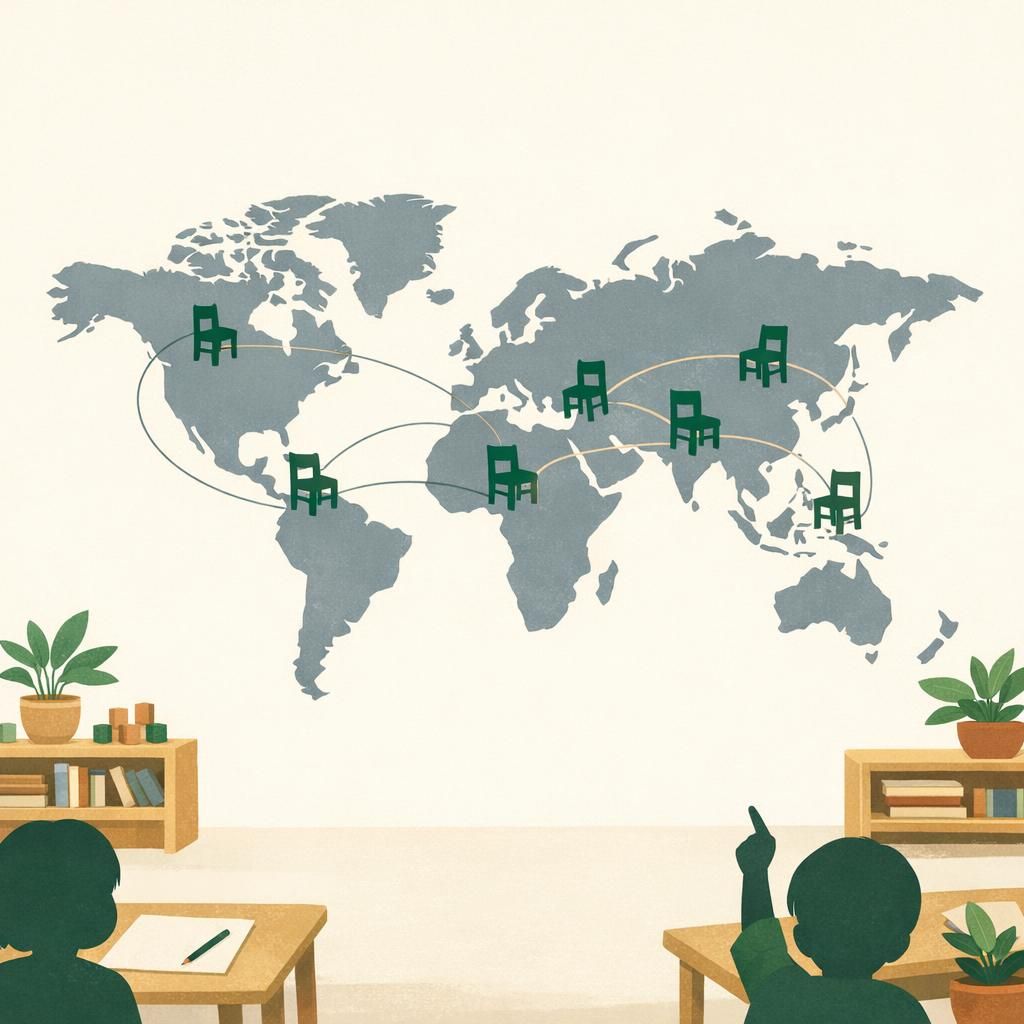
Democratic schools — schools where governance is shared between students and adults, often through an assembly with one-person-one-vote — exist on every inhabited continent. The current landscape combines historic institutions (Summerhill in England since 1921, Sudbury Valley in the USA since 1968) with a more recent wave of foundations that has accelerated since the 2000s. This article surveys the situation as of 2026.
The reference models
Two models dominate contemporary references:
The Summerhillian model
Summerhill, in Suffolk, England, founded by A.S. Neill in 1921, is the longest continuously operating democratic school. It offers classes but with non-mandatory attendance, and operates a weekly school meeting where rules are made and disputes resolved. Currently it remains active as a boarding school accommodating students aged 5 to 18 from a number of countries, in an environment that values autonomy in ways comparable to Montessori principles.
The Sudbury model
Sudbury Valley School, in Framingham, Massachusetts, founded in 1968, is often cited among Sudbury-style democratic schools and does not organize classes at all. Students structure their own time. The school meeting and a judicial committee handle all governance. Diplomas are granted after a thesis defense before an internal and external jury.
Sudbury-inspired schools have proliferated since the late 1990s. The Sudbury Valley network publishes resources and case studies; some 50 schools worldwide identify directly with the Sudbury model.
Regional networks
EUDEC: Europe
The European Democratic Education Community (EUDEC), established in 2008, federates democratic schools across Europe. It hosts an annual conference (held in a different European city each year), maintains directories of member schools, and supports founders of new initiatives. As of 2026, EUDEC counts member schools in Germany, France, the Netherlands, Belgium, Spain, Italy, Poland, the United Kingdom, the Nordic countries, and elsewhere.
EUDEC has been particularly active in supporting new schools through founding support documents, charters, and a code of ethics.
IDEC: international
The International Democratic Education Conference (IDEC), held annually since 1993 (with rare interruptions), brings together democratic schools and educators from all continents. The host country rotates. IDEC conferences have been held in Israel, India, New Zealand, Japan, Brazil, Korea, the USA, the UK, Germany, Ukraine, and elsewhere.
Other regional groupings
Latin America has seen a marked growth of democratic schools, often referred to as escuelas libres or escuelas democráticas, with networks in Mexico, Brazil, Argentina, Colombia, Chile.
Asia counts established schools in Israel (Hadera, since 1987, a major reference), India, Japan, Korea, Taiwan, the Philippines.
Africa has emerging initiatives, particularly in South Africa and Kenya, often connecting democratic principles with critiques of colonial educational legacies.
Regulatory environments
The relationship between democratic schools and national regulatory frameworks varies considerably.
In countries with strong compulsory schooling laws (France, Germany, most European countries), democratic schools generally operate as private institutions subject to inspection. They must demonstrate that students acquire the legally required learning, often through periodic assessment.
In countries where homeschooling is legally recognized as an equivalent to schooling (United States in all states, United Kingdom, parts of Canada and Australia), some democratic schools operate under variants of homeschooling status.
The 2021 French law on the principles of the Republic tightened the rules for opening private schools out of contract, requiring prior authorization rather than declaration. This change has affected the founding pace of new democratic schools in France since.
The professional question
Working as a staff member in a democratic school presents distinctive demands. Unlike teachers in a traditional school, staff in a democratic school have no curricular authority to fall back on: their pedagogical legitimacy rests on the relationships they build with students and on the resources they make accessible.
Most democratic schools recruit staff with diverse academic and professional backgrounds — academic teachers, artists, craftspeople, scientists, but also professionals from unrelated fields who bring an adult life to share with students. The teaching certification standards applicable in traditional schools do not always apply directly.
Several democratic schools have developed internal training pathways for new staff, generally combining intensive observation in established schools with mentored entry into staff responsibility.
Outcomes
The question of outcomes for democratic-school graduates is regularly raised. Several studies, especially the long-running Sudbury Valley alumni surveys, indicate that graduates pursue further studies and professional paths in proportions comparable to other school populations, with self-reported higher autonomy and self-direction.
These studies have limitations (self-selection of respondents, self-selection of families choosing democratic schools, absence of randomized control). The comparison with mainstream schools is intrinsically difficult.
Current tensions and debates
Several questions structure ongoing debate within and around democratic schools:
- Access and equity: as private institutions, most democratic schools recruit from families able to pay fees. Sliding-scale tuition is widespread but does not solve the structural question of who has access.
- Articulation with formal credentials: students preparing for university or for credentialed professional paths must engage with examination systems at some point.
- Sustainability of small institutions: small staff, small student bodies, modest financial reserves make many democratic schools fragile to leadership transitions or family departures.
- Reproduction of pedagogical posture: training new staff in the radically non-directive posture of democratic schools is challenging and time-consuming.
Sources and further reading
- EUDEC: eudec.org
- Sudbury Valley School: sudburyvalley.org
- Summerhill School: summerhillschool.co.uk
- IDEC archives: idec-network.org
- Peter Gray, Free to Learn, Basic Books.