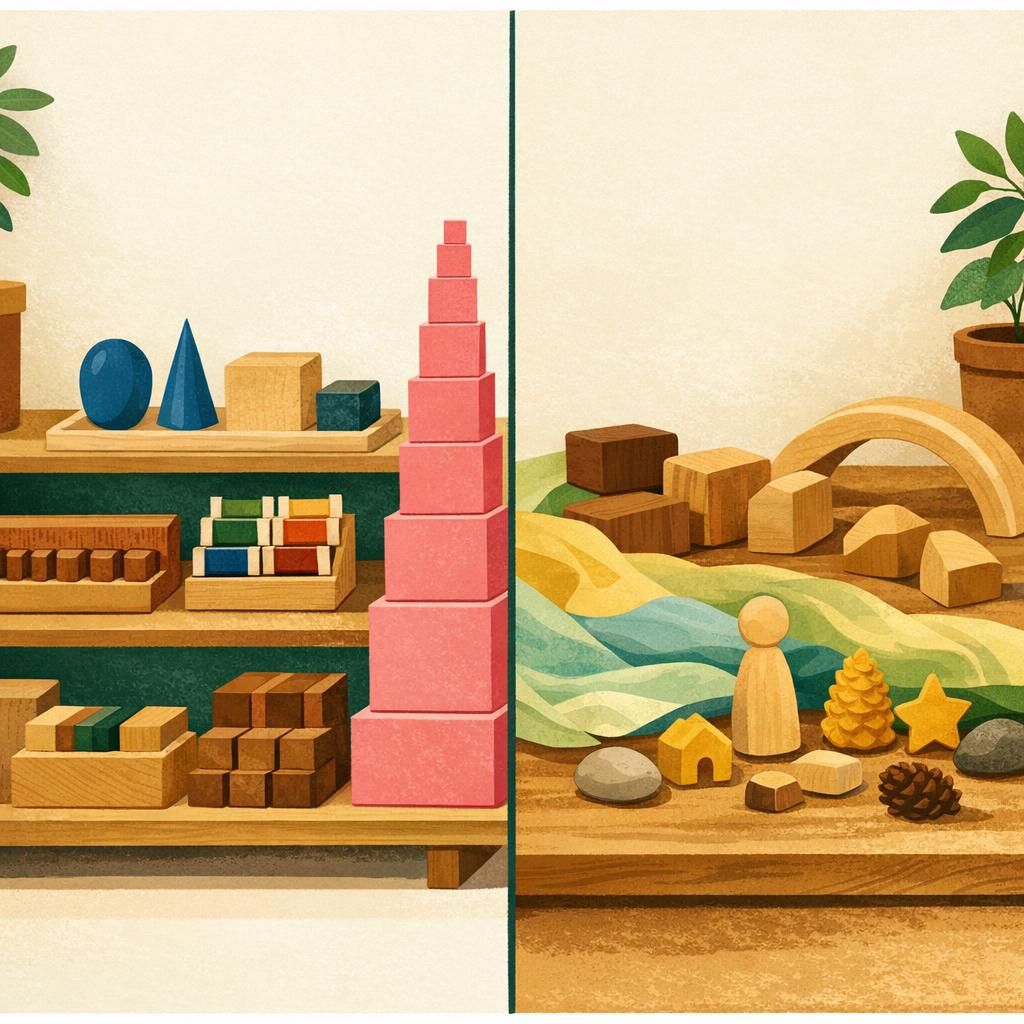
Among alternative pedagogies internationally implemented at scale, Montessori and Waldorf (also called Steiner) are the two most established. They emerged within fifteen years of each other (Montessori in 1907, Waldorf in 1919), both as responses to perceived shortcomings of standard schooling, both with explicit anthropological foundations. Parents and educators routinely compare them. This article proposes a structured analytical comparison, without favoring one over the other.
Anthropological foundations
Both pedagogies are grounded in explicit views of human development, but the foundations differ substantially.
Maria Montessori developed her approach from clinical observation, initially of children with developmental difficulties at the Orthophrenic School in Rome, then of typically developing children at the first Casa dei Bambini in 1907. Her framework draws on a scientific naturalist tradition, with theological undertones (her Catholic background was acknowledged), but it is presented primarily as an observational science of child development.
Rudolf Steiner founded the first Waldorf school in 1919 in Stuttgart on the explicit basis of anthroposophy, the spiritual-philosophical system he had elaborated since the early 1900s. Anthroposophy includes views on the human being as a triune body-soul-spirit, on reincarnation, on a developmental schema in seven-year cycles, and on a broader esoteric cosmology.
This distinction matters practically: Montessori schools generally present themselves as non-religious; Waldorf schools acknowledge an anthroposophical inspiration without necessarily teaching anthroposophy to children. Families considering either should engage directly with this dimension during school visits.
Early childhood (3-6)
Montessori 3-6: the Children's House
In Montessori, the 3-6 environment ("Casa dei Bambini" or "Children's House") is structured around the prepared environment: low shelves, child-scaled furniture, defined zones (practical life, sensorial, language, mathematics, culture), specific materials manipulated individually or in pairs. The child chooses among materials previously presented, works for sustained periods, and benefits from age-mixed company (3, 4, 5-year-olds in the same room).
Formal academic preparation (early reading, mathematical concepts) is offered through manipulable materials from age 3-4, depending on individual readiness observed by the teacher.
Waldorf 3-6: the Kindergarten
In Waldorf kindergartens, the environment is also carefully prepared but along different lines: natural materials, muted colors, open-ended play materials (silks, wooden blocks, simple dolls), absence of plastic and electronic media. The day is structured around meaningful adult activity, baking, gardening, woodwork, seasonal celebrations, which children observe and imitate.
Formal academic preparation is intentionally deferred: reading and writing are not introduced until around age 7 (entry to first grade). This deferral is a deliberate developmental choice based on Steiner's view that the first seven years should be reserved for sensorial, motor, and imaginative development.
Elementary years (6-12)
Montessori 6-12: the Cosmic Education
The Montessori 6-12 curriculum is organized around Cosmic Education: five "Great Lessons" that present the story of the universe, the emergence of life, the appearance of humans, the development of writing, and the development of mathematics. These narratives anchor subsequent specific studies, geometry, geography, history, biology, language, music, and can be compared with les sept périodes de l’enfance décrites dans la pédagogie Waldorf.
Classes mix children from 6 to 9, and 9 to 12. Materials remain prominent but become more conceptually abstract. Children typically pursue research projects individually or in small groups, supported by the prepared environment and a relatively non-interventionist teacher posture.
Waldorf elementary: the class teacher
A distinctive Waldorf feature is the class teacher who ideally accompanies the same group of children from first grade through eighth grade (ages 6 to 14). The teacher introduces all main subjects, with specialists for languages, eurythmy, music, and crafts.
Teaching is organized in main lesson blocks of three to four weeks on a single subject, presented in the morning. Children produce illustrated main lesson books that replace standard textbooks. Each subject is approached at the developmentally appropriate moment as understood within Steiner's framework.
Materials
Both pedagogies value carefully selected materials, but in different ways.
In the Montessori method, materials are precisely engineered, standardized across the international network, designed for specific isolated learning purposes. The set is extensive (hundreds of pieces for a full classroom) and the producers are specialized (Nienhuis, Gonzagarredi).
Waldorf materials are simpler, often handmade, with deliberate roughness ("the child completes what the material lacks"). Natural materials predominate: wool, wood, stone, beeswax. Less material is used; more time is spent with each piece.
Evaluation
Neither pedagogy uses traditional grading systems through the elementary years.
Montessori: progression is tracked through observation logs and through the child's interaction with materials, which themselves embed self-correction.
Waldorf: bulletins are narrative; quantitative grades are introduced only in the final years of secondary school, in preparation for external examinations.
Teacher training
Both have established international training networks:
- Montessori: AMI (Association Montessori Internationale) and AMS (American Montessori Society) deliver multi-year diploma courses for each age range.
- Waldorf: Waldorf teacher training programs are organized through national federations and at dedicated training institutes; the Bund der Freien Waldorfschulen in Germany maintains historical reference standards.
What the comparison can, and cannot, settle
Comparison can clarify the structural choices each pedagogy makes. It cannot, by itself, settle which is "better": the answer depends on what a family or educator values, on the specific school being considered, on the child's temperament and on practical constraints (location, cost, continuity).
The most useful comparison for a family is rarely abstract: it is between two specific schools in their actual geographic and human reality, visited in person, with attention to how the published principles are concretely embodied in the daily life of that school.
Sources and further reading
- Maria Montessori, The Absorbent Mind, multiple editions.
- Rudolf Steiner, The Education of the Child, Anthroposophic Press.
- Paula Polk Lillard, Montessori Today, Schocken.
- Christopher Clouder & Martyn Rawson, Waldorf Education, Floris Books.