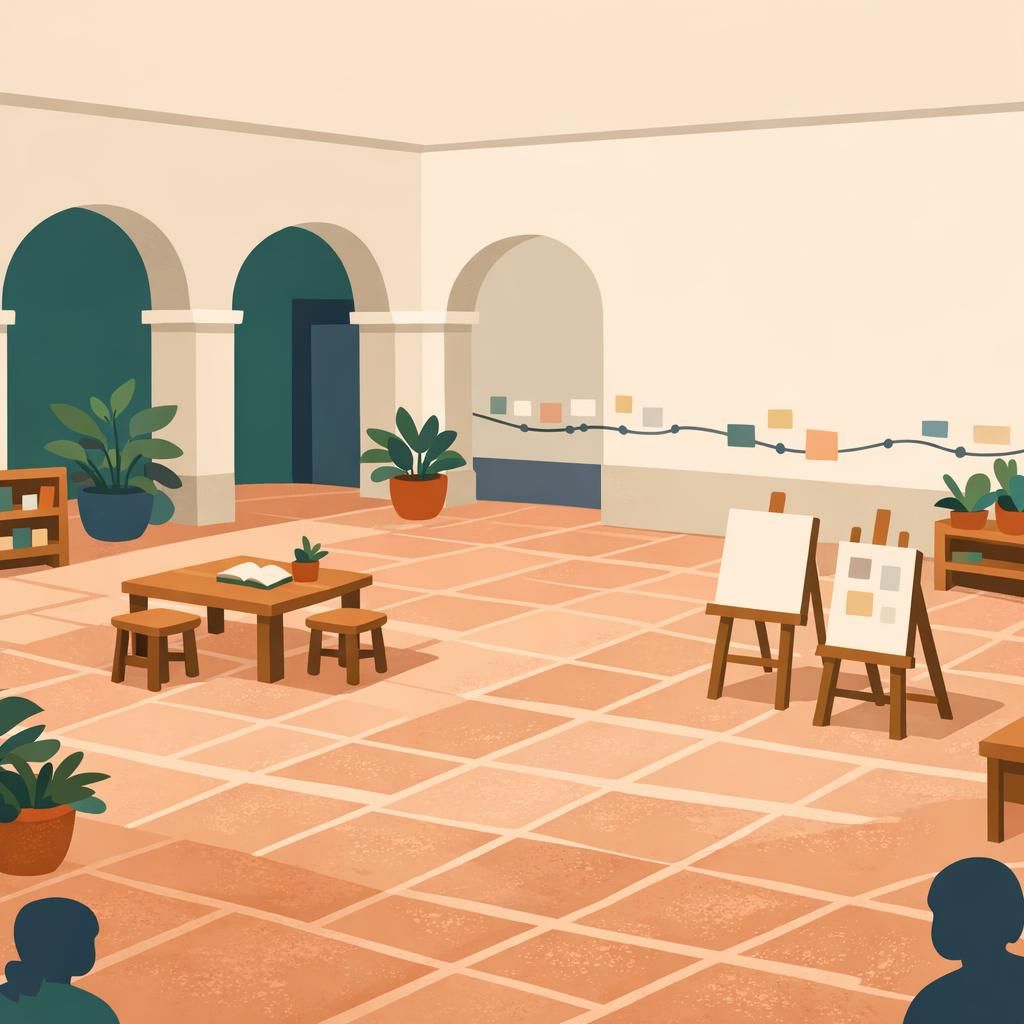
The Reggio Emilia approach emerged in a specific historical and geographical context: the small Italian city of Reggio nell'Emilia, in the Emilia-Romagna region, in the aftermath of the Second World War. Its founder, Loris Malaguzzi (1920-1994), led a collective effort that initially produced a municipal network of infant-toddler centers and preschools. Today, the approach is recognized internationally, with study tours, conferences, and adaptation projects on every continent.
This article reviews the historical conditions that made Reggio possible, the key principles that distinguish it from other early-childhood traditions, and the conditions under which it can — and cannot — be transplanted into other contexts.
Postwar foundations
The story commonly told dates the origin of Reggio's municipal preschool network to 1945, in a small village near Reggio (Villa Cella). Families decided to build a preschool with materials retrieved from war ruins, including bricks from destroyed buildings. Loris Malaguzzi, then a young educator, joined the effort, and the experience became the seed of a broader municipal commitment.
The municipality of Reggio Emilia formally established its public preschool system in 1963, and infant-toddler centers in the 1970s. The political context of the time — Reggio Emilia was governed by a left-wing coalition that prioritized social policy — was central to this institutional commitment.
The image of the child
The most cited concept of Reggio pedagogy is its image of the child: a competent, capable, creative subject, born curious, equipped with what Malaguzzi famously called the hundred languages — symbolic, expressive, communicative resources that go far beyond verbal language alone.
This image is not an empirical claim that all children manifest these qualities visibly; it is a philosophical and political stance, a starting hypothesis for educators. From this stance derive the architectural, organizational, and pedagogical choices that distinguish a Reggio preschool from other models.
The pedagogy of relationships
Reggio places relationships at the center: between children, between children and adults, between school and family, between school and city. The pedagogy of relationships is not a slogan but an organizing principle that shapes daily practice.
Concretely, a Reggio preschool maintains very close relationships with families (frequent meetings, parental presence in the school, joint decisions on projects), with other classes within the school, and with the surrounding municipal context. The school is conceived as a public space rather than an isolated educational institution.
The atelier and the atelierista
Every preschool in the Reggio Emilia municipal network has an atelier, an artistic studio space, and an atelierista, an artist-educator who shares responsibility for the pedagogical work alongside teachers. The atelier is not a frill: it embodies the conviction that artistic and expressive languages are fundamental to children's thinking, not supplementary.
This feature has been particularly difficult to transpose internationally. Few educational systems can afford an atelierista in every preschool. Adaptations in other countries have variously approximated this by sharing an atelierista across schools, by training existing teachers in expressive media, or by partnering with local artists.
Documentation as a tool for thinking
The practice of pedagogical documentation is perhaps Reggio's most exportable contribution. Teachers continuously document children's words, drawings, productions, and sequences of activity, then analyze and present this material on the walls, in portfolios, and in publications.
Documentation serves several functions: it makes children's thinking visible to teachers, who can then deepen their understanding; it allows teachers to dialogue with each other about practice; it gives families access to what their children actually do at school; it constitutes a memory of the school's pedagogical work.
Unlike compliance-driven evaluation forms common in many systems, documentation is a tool for thinking, not a bureaucratic exercise.
Project work and emergent curriculum
Reggio classrooms work largely through projects (called progettazione) that emerge from children's interests rather than from a pre-set curriculum. A project may last weeks or months. It is co-constructed between children and adults, often involves the wider community, and produces a documented outcome.
This approach contrasts with curricula organized by skills checklists or thematic schedules. It supposes a high level of professional skill in the teachers, who must observe sharply, interpret children's interests, and propose meaningful extensions.
Reggio Children and the international network
To organize the international visibility of the approach, the city of Reggio Emilia created Reggio Children in 1994. The organization runs study tours in Reggio, organizes conferences, publishes books and documentation, and hosts educators from around the world.
The International Centre Loris Malaguzzi, opened in 2006 in a renovated factory in Reggio, is the physical hub of these activities.
The limits of transplantation
Several factors make Reggio difficult to transplant integrally:
- The municipal commitment: Reggio's preschools are publicly funded and politically supported at the local level. Importing the approach without comparable public commitment relies on private resources and risks limiting access.
- Teacher-student ratios: Reggio classrooms typically have two teachers for around 25 children, plus an atelierista. Few systems offer comparable staffing.
- Continuous professional development: teachers in Reggio engage in collective pedagogical inquiry as a routine part of their work. This depends on dedicated time that many systems do not provide.
- Cultural context: the Italian conception of childhood, the community life of Reggio Emilia, the Italian municipal tradition all shape the approach. Transplanting it without translation is unrealistic.
Internationally, the most fruitful adaptations have generally focused on specific transferable elements — documentation, project work, and the role of materials and space in a Reggio Emilia classroom — rather than attempting to reproduce the model integrally, a pattern also visible in comparisons between Montessori and Waldorf approaches.
Sources and further reading
- Carla Rinaldi, In Dialogue with Reggio Emilia: Listening, Researching and Learning, Routledge.
- Loris Malaguzzi, The Hundred Languages of Children, multiple editions.
- Reggio Children: reggiochildren.it
- North American Reggio Emilia Alliance: reggioalliance.org